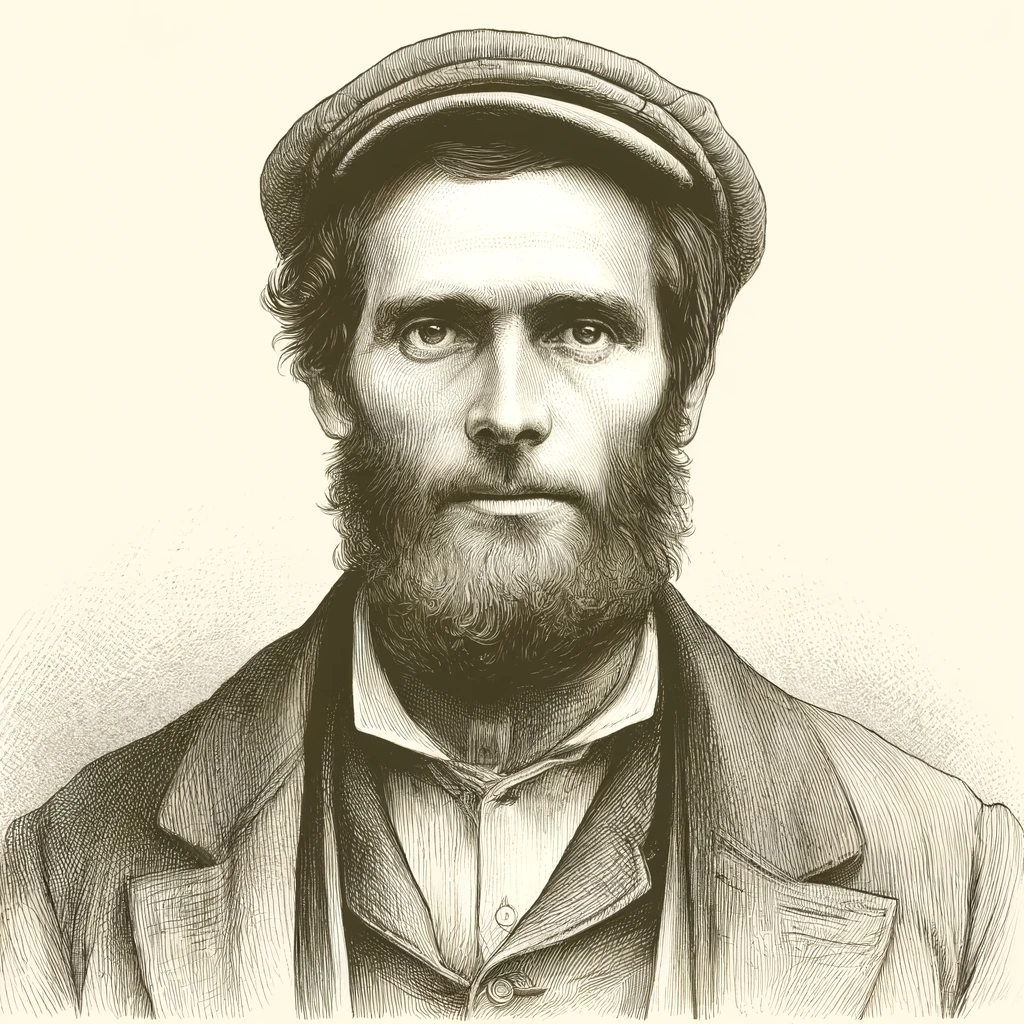
James Jennings Smith (1811–?)
James Jennings was probably born in 1811n1. His parents are not known. He is Ian's 4x great grandfather.
He married Elizabeth Cummings (1811–?)★ before 1832 . They had seven children:–
- Elizabeth Jennings baptised on 16 Dec, 1832 at St. Nicholas' Church in Hetton le Hole, County Durham, Englandb1.
- Susannah baptised on 17 Dec, 1832 at St. Nicholas' Church, Hetton le Holeb2. Married Ralph Rodgerson on 20 Mar, 1848 at Christ Church in Tynemouth, Northumberland, Englandc1. Died in the Oct-Dec quarter of 1912 in the registration district of Durham in County Durham, Englandd1 at the age of eighty.
- Rebecca Jennings baptised on 1 Jul, 1836 at Holy Trinity Church in Sunderland, County Durham, Englandb3. Married George Norvell on 29 Jul, 1855 at Christ Church, Tynemouthe1. Died in the Jul-Sep quarter of 1889 in the registration district of Tynemouth in Northumberland, Englandd2 at the age of fifty-five.
- James Jennings died age one. Born in Feb 1836 at Burleigh Street in Sunderland, County Durham, Englandb4. Buried on 30 Apr, 1837 at Holy Trinity Church, Sunderlandb4.
- James Jennings baptised on Whitsun, 3 Jun 1838 at St. Cuthbert's Church in Darlington, County Durham, Englandb5.
- Jemima born in 1841 in the parish of North Shields in Northumberland, England. Married William Barlow in 1858 at Christ Church, Tynemouthe2 and Patrick Fitzgerald in 1881 in Gillingham in Kent, England. Died on 1 Mar, 1903 in Gillinghamf1 at the age of sixty-two.
- Dinah★ born on 6 Jun, 1842 and baptised on 19 Nov, 1848 at St. Hilda's Church in South Shields St. Hilda, County Durham, Englandb6,g1. Married John Peak★ on 19 Jul, 1858 in the parish of South Shields in County Durham, Englandh1. Buried in Jan 1900 in Preston Cemetery in Tynemouth, Northumberland, Englandf2.
By the time of the 1841 census he was living at Prudhoe Street in Newcastle St. Andrew, Northumberland, Englandk1 with his wife Elizabeth and four children Susannah, Elizabeth Jennings, Rebecca Jennings and Jemima.
Around March 1848, James Jennings Smith joined the Lion steamship as its chief engineer. The Lion was a substantial steamship, approximately 600-700 tons, owned by Messrs. Malcolmson Brothers of Waterford. For this, Smith earned a substantial salary of £21 15s per week. Over the following months, he worked without incident, ensuring the smooth operation of the ship on its regular voyages between London and Friesland, Holland. However, events in mid-September would dramatically change the course of his career.m1,p1
The Lion left London on 13 Sep 1848, heading for Harlingen, Friesland. Once in Holland the ship loaded a valuable cargo, including butter, cheese, flax, oil, and livestock, which were to be sold in London’s markets. On the morning of 16 Sep 1848, tensions aboard the Lion came to a head. While docked in Harlingen and preparing for the return voyage, James attempted to load several baskets of poultry onto the ship for his own sale in London. Though it was customary for crew members to bring provisions aboard, Captain Neville refused permission, citing the excessive amount. This refusal enraged James, who openly threatened to stop the ship’s operation. He ordered the firemen to "rake the fires out," effectively disabling the steam engine. Despite Neville’s attempts to de-escalate the situation, Smith persisted in his defiance, and the majority of the crew followed his lead by deserting their posts. The ship, now understaffed and unable to sail, faced a costly delay that threatened its cargo and the shipowners’ profits.p1,q1,m1
For the next three days, the Lion remained stranded in Harlingen. Captain Neville, along with local authorities and agents, made several attempts to convince Smith and the crew to return to their duties, but Smith resisted. He continued to taunt Neville, calling out from the shore and mocking his inability to move the ship. The crew’s refusal to return to work resulted in significant financial losses, as the perishable goods had to be offloaded and new engineers hired.m1
On 23 Oct 1848, James and eight other crew members stood trial at the Old Bailey, facing charges of "piratical revolt." The prosecution argued that Smith, as the leader, had deliberately incited the crew to abandon their posts, jeopardising the ship and its cargo. Captain Neville’s testimony, along with witness statements, confirmed that Smith had ordered the fires to be extinguished and had urged the crew to join him in defying the captain. After the trial at the Old Bailey, James and the other crew members were remanded in custody overnight in Newgate Prison to await the verdict. Ultimately it was decided that no formal agreements had been made between the crew and the captain, a crucial oversight under maritime law. As a result, the charges of mutiny were dismissed, and James and the crew were acquitted.m1,q1,r1,p1
Following his acquittal, James pursued a legal case of his own on 30 November 1848, seeking unpaid wages for the week ending 16 September. He claimed that he had been wrongfully dismissed by Captain Neville during the poultry dispute, insisting that he had left the ship under the captain’s orders to prevent a boiler accident. However, Captain Neville maintained that James had abandoned the ship voluntarily, encouraging the crew to do the same. Witness testimony from engineers called by James contradicted his version of events, revealing that Neville had attempted to reconcile with him and even offered him payment to return to his duties. The court ruled against James, denying him the full week’s wages but awarding him two days’ pay for the work completed before the incident, along with the costs of bringing the case to court.m2,q2
The time and place of James Jennings' death is not known.
Timeline
- 1811
- Probably born around this time.n1
- 1832
- 16 Dec
- Daughter, Elizabeth Jennings Smith (1832–?), baptised at St. Nicholas' Church, Hetton le Hole, County Durham, England.b1
Occupation recorded as engineer.b1,b2
Recorded as living at Hetton Houses, Hetton le Hole, County Durham, England.b1,b2 - 17 Dec
- Daughter, Susannah Smith (1832–1912), baptised at St. Nicholas' Church, Hetton le Hole.b2
- 1834
- 2 Oct
- Daughter, Rebecca Jennings Smith (1834–1889), born in Sunderland, County Durham, England.b3
- 1836
- Feb
- Son, James Jennings Smith (1836–1837), born at Burleigh Street, Sunderland, County Durham, England.b4
- 1 Jul
- Occupation recorded as engineman.b3
Recorded as residing at Burleigh Street, Sunderland.b3
- 1837
- 30 Apr
- Son, James Jennings Smith (1836–1837), buried at Holy Trinity Church, Sunderland, County Durham, England.b4
- 1838
- 17 May
- Son, James Jennings Smith (1838–?), born in Darlington, County Durham, England.h2
Occupation recorded as engineer.h2 - 3 Jun
- Recorded as residing in Darlington.b5
Occupation recorded as engineer.b5
- 1841
- Daughter, Jemima Smith (1841–1903), born in North Shields, Northumberland, England.
- 6 Jun
- Recorded in the 1841 census residing at Prudhoe Street, Newcastle St. Andrew, Northumberland, England.k1
Occupation recorded as engineer.k1
- 1842
- 6 Jun
- Daughter, Dinah Smith (1842–1900)★, born in Jarrow, County Durham, England.h3,g1
- 12 Jun
- Occupation recorded as engineman.h3
- 1848
- 13 Sep
- Occupation recorded as chief engineer aboard the Lion.p1
- 27 Sep
- Tried before the Lord Mayor on a charge of piratical revolt at Mansion House, London, England.m1,r1
Remanded in custody.m1 - 4 Oct
- Bailed after final hearing on the charge of piratical revolt at Mansion House.q1
Bailed to await trial at Old Bailey.q1 - 31 Oct
- Remanded in custody to await verdict Newgate Prison, London, England.s1
Tried on a charge of piratical revolt at The Old Bailey, London, England.p1 - 1 Nov
- Left Newgate Prison.s1
- 9 Nov
- Occupation recorded as engineer.b6
Recorded as residing in South Shields, County Durham, England.b6 - 19 Nov
- Recorded as living in South Shields.g1
Occupation recorded as engineer.g1
- 1858
- 19 Jul
- Occupation recorded as engine wright.h1
- 1889
- Jul-Sep
- Daughter, Rebecca Jennings Smith (1834–1889), died in Tynemouth, Northumberland, England.d2
- 1900
- 30 Jan
- Daughter, Dinah, died at 24 Beacon Street, Tynemouth, Northumberland, England.h4,t1
- 1903
- 1 Mar
- Daughter, Jemima Smith (1841–1903), died in Gillingham, Kent, England.f1
- 1912
- Oct-Dec
- Daughter, Susannah Smith (1832–1912), died in Durham, County Durham, England.d1
Facts
estimated 1811
(not known)
(not known)
(not known)