No 3346, 30 Nov 1848, Page 1, Cols 5 and 6, Curious Case of Sea Wages
Cited from Shipping and Mercantile Gazette
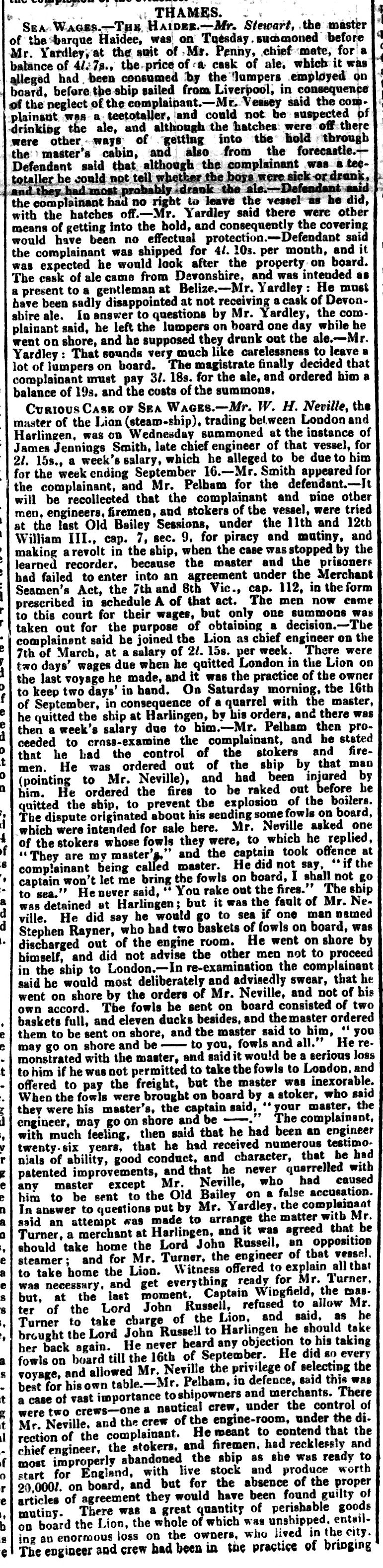
Shipping and Mercantile Gazette, No 3346, 30 Nov 1848, Page 1, Col 5, Curious Case of Sea Wages, James Jennings Smith (Download this image)
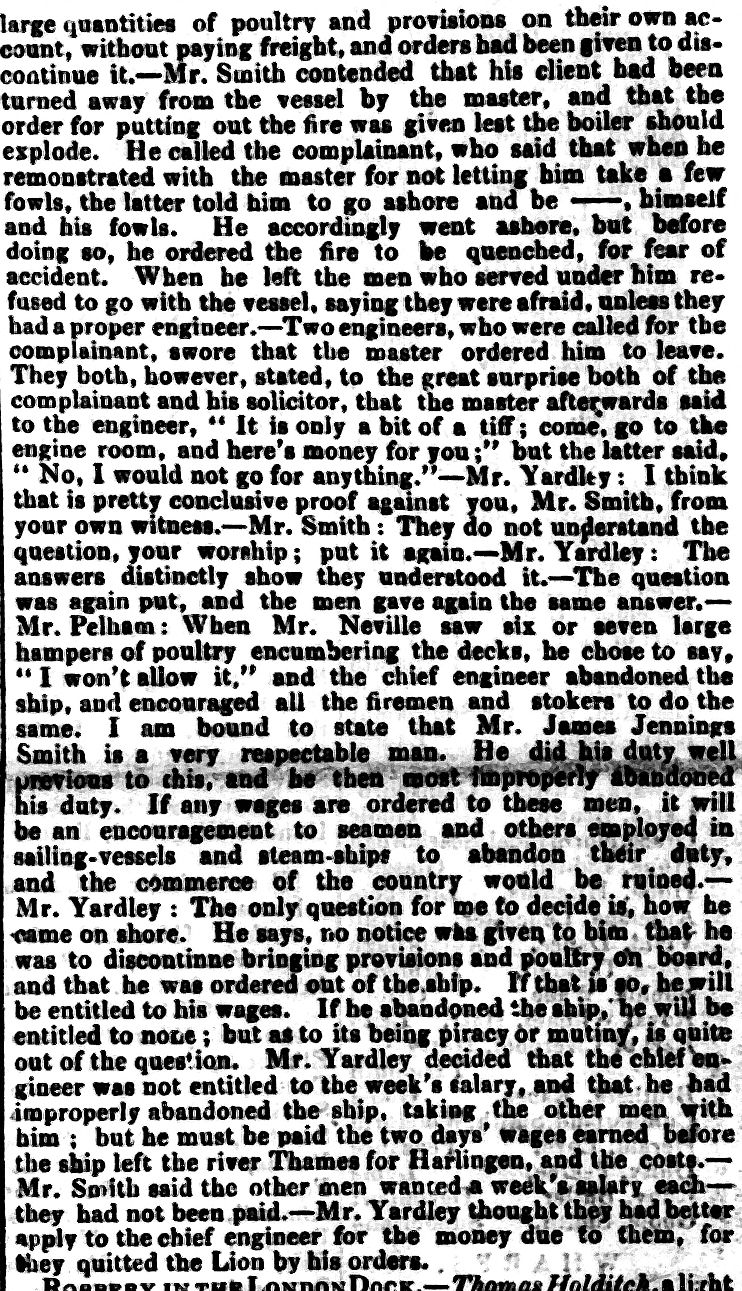
Shipping and Mercantile Gazette, No 3346, 30 Nov 1848, Page 1, Col 6, Curious Case of Sea Wages Contd, James Jennings Smith (Download this image)
Transcription
CURIOUS CASE OF SEA WAGES. - Mr. W. H. Neville, the master of the Lion (steam-ship), trading between London and Harlingen, was on Wednesday summoned at the instance of James Jennings Smith, late chief engineer of that vessel, for 21l. 15s., a week's salary, which he alleged to be due to him for the week ending September 16. - Mr. Smith appeared for the complainant, and Mr. Pelham for the defendant. - It will be recollected that the complainant and nine other men, engineers, firemen, and stokers of the vessel, were tried at the last Old Bailey Sessions, under the 11th and 12th William III., cap. 7, sec. 9, for piracy and mutiny, and making a revolt in the ship, when the case was stopped by the learned recorder, because the master and the prisoner had failed to enter into an agreement under the Merchant Seamen's Act, the 7th and 8th Vic., cap. 112, in the form prescribed in schedule A of that act. The men now came to this court for their wages, but only one summons was taken out for the purpose of obtaining a decision. - The complainant had joined the vessel as chief engineer on the 31st of March, at a salary of 21l. 15s. per week. There were two years' wages due when he quitted London the Lion on the 31st of September, and it was the practice of the ship to pay monthly wages in hand. On Saturday morning, the 16th of September, in consequence of a quarrel with the master, while the ship was at Harlingen, by his orders the fires were put out and the ship was left. - Mr. Pelham then proceeded to cross-examine the complainant, and in the statement of the defence, said the captain of the ship had allowed him to bring on board fowls for sale, but the persons who were involved in the shipment took offence at his making too many fowls. He ordered the fires to be raked out before he quitted the ship, to prevent the explosion of the boilers. The dispute originated about his sending some fowls on board, which were intended for sale here. - Mr. Neville asked one of the stokers whose fowls they were, to which he replied, "They are my master's," and the captain took offence at complainant being called a master. He did not say, "if the captain won't let me bring the fowls on board, I shall not go to sea." He never said, "You take out the fires." The ship was detained at Harlingen; but it was the fault of Mr. Neville. He did say he would go to sea if one man named Charles Rayner, who had two baskets of fowls on board, was discharged out of the engine room. He went on shore by himself, and did not advise the other men not to proceed in the ship to London. - In re-examination the complainant said he would most deliberately and advisedly swear, that he went on shore by the orders of Mr. Neville, and not of his own accord. The fowls he sent on board consisted of two baskets full and eleven ducks besides, and the master ordered the voyage to be sent on shore, and the master said to him, "if you won't go on shore and be ---- to you, fowls and all." He refused to go, and the matter, and said it would be a serious loss to the complainant not to take the fowls to London, and complainant took the freight, but the master was inexorable. There was a great quantity of perishable goods on board the Lion, the whole of which was unshipped, entailing an enormous loss on the shippers who lived in the city. The engineer and crew had been in the practice of bringing large quantities of poultry and provisions on their own account, without paying freight, and orders had been given to discontinue it. - Mr. Smith contended that his client had been turned away from the vessel by the master, and that the order for putting out the fire was given lest the boiler should explode. He called the complainant, who said that when he remonstrated with the master for not letting him take a few fowls, the latter told him to go ashore and be ---- himself and his fowls. He accordingly went ashore, but before doing so, he ordered the fire to be quenched, for fear of accident. When he left the men who served under him refused to go with the vessel, saying they were afraid, unless they had a proper engineer. - Two engineers, who were called for the complainant, swore that the master ordered him to leave. They both, however, stated, to the great surprise both of the complainant and his solicitor, that the master afterwards said to the engineer, "It is only a bit of a tiff; come, go to the engine room, and here’s money for you," but the latter said, "No, I would not go for anything." - Mr. Yardley: I think that is pretty conclusive proof against you, Mr. Smith, from your own witness. - Mr. Smith: They do not understand the question, your worship; put it again. - Mr. Yardley: The answers distinctly show they understood it. - The question was again put, and the men gave again the same answer.Mr. Pelham: When Mr. Neville saw six or seven large hampers of poultry encumbering the deck, he chose to say, “I won’t allow it,” and the chief engineer abandoned the ship, and encouraged all the firemen and stokers to do the same. I am bound to state that Mr. James Jennings Smith is a very respectable man. He did his duty. He believed this, and he then most improperly abandoned his duty. If any wages are ordered to these men, it will be an encouragement to seamen and others employed in sailing-vessels and steam-ships to abandon their duty, and the commerce of the country would be ruined. - Mr. Yardley: The only question for me to decide is, how he came on shore. He says, no notice was given to him that he was to discontinue bringing provisions and poultry on board and that he was ordered out of the ship. If that is so, he will be entitled to his wages. If he abandoned the ship, he will be entitled to none; but as to its being piracy or mutiny, it is quite out of the question. Mr. Yardley decided that the chief engineer was not entitled to the week’s salary, and that he had improperly abandoned the ship, taking the other men with him; but he must be paid the two days’ wages earned before the ship left the river Thames for Harlingen, and the costs. - Mr. Smith said the other men wanted a week’s salary each - they had not been paid. - Mr. Yardley thought they had better apply to the chief engineer for the money due to them, as they quitted the Lion by his orders.
Full Citation
Shipping and Mercantile Gazette; No 3346, 30 Nov 1848, Page 1, Cols 5 and 6, Curious Case of Sea Wages.
Source
Shipping and Mercantile Gazette
Available at:
- Findmypast. https://www.findmypast.co.uk/newspapers/england/shipping-and-mercantile-gazette
- The British Newspaper Archive. https://www.britishnewspaperarchive.co.uk/titles/shipping-and-mercantile-gazette