No 20687, 4 Oct 1848, Page 7, Cols 4 and 5, Police, Mansion House, Piratical Revolt
Cited from Morning Herald (London)

Morning Herald London, No 20687, 4 Oct 1848, Page 7, Col 4, Police, Mansion House, Piratical Revolt, James Jenning Smith (Download this image)
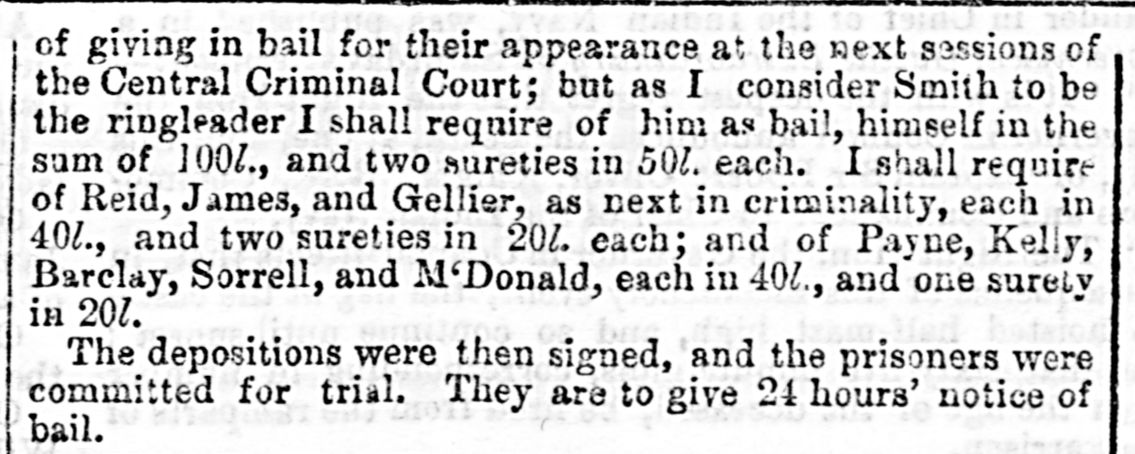
Morning Herald London, No 20687, 4 Oct 1848, Page 7, Col 5, Police, Mansion House, Piratical Revolt Contd, James Jenning Smith (Download this image)
Transcription
POLICE.MANSION HOUSE.-PIRATICAL REVOLT-James Jennings Smith, first engineer, and Alexander Reid, second angineer, of the Lion, steamer, trading between London and Holland, and John James, David Gellier, Jonas Payne, John Kelly, Robert Barclay, Edward Sorrell, and John M’Donald, firemen and engineers, wree[sic] brought up for final examination upon the charge of piratical revolt.
Mr. Pelham attended for the prosecution, and Mr. Smith. defended all the prisoners.
Mr. Robinson, agent to Messrs. Malcolmson, Brothers, of Waterford, owners of the vessel, gave testimony as to the proprietorship.
The Lion, steam-vessel, cost, we were given to understand, the sum of 20,000l., and the cargo on board when the prisoners abandoned her at Harlingen was valued at 40,000l.
Rayner, the fireman who remained on board the Lion when the prisoners deserted the vessel, was called by Mr. Pelham.-He confirmed the evidence given by Captain Neville, the master of the vessel, upon the first examination, as to the conduct of Smith, the first engineer, in inciting all the rest to abandon the vessel on the 16th September, when she was to sail for England, at nine o’clock in the morning. The captain, he added, asked me, in the presence of a gentleman whom he brought on board, whether I was willing to to work? I said yes, and M’Donald said the same. All the rest refused. They said they would not go home in the vessel without Smith did. Smith said to them, “Mind what you say, you —-, or that fellow will get hold of your words.” Gellier came on board again, and said he would do for me before I want home in the ship. This was after the refusal, and he was taken on shore by the police. I got the steam of the vessel up, but I did not attempt to go on, for I did not know anything of engineering.
Mr. Smith (for the prisoners).-Did not the men say they could not go home without a competent engineer?
Witness.—No; they said they would not go home without Smith.
Did not M’Donald remain quistly behind when the others went?—He did.
Did he not do his part of the work, and behave well on board?—He believed[sic] very well on board, but he behaved unhandsomely when he left me. Two or three of the prisoners came on board, and asked him if he had any Scotch blood, and he said “Yes.” They then said, “Come with us,” and he went with them.
Joseph Kavanaugh, second mate of the Lion, said I was in the vessel at Harlingen, on the 16th of September, and I saw the baskets of fowls brought brought on on board there, and heard the captain inquire to whom they belonged. The answer was the first engineer. I heard the captain aay there were five or six already brought on board, and he could not allow it. I was stowing away the cattle on the second deck. and I heard Smith’s voice afterwards ordering the men to draw the fires-(The witness here repeated the revolting epithets and oaths used by the first engineer.) Smith said he would not go in the vessel, and after the fires were drawn, all the prisoners went on shore except Rayner and M’Donald. Afterwards Gellier, James Payne, and Barclay came on board and asked me what I was doing there. I said I was left in charge of the engine-room, and I refused to let them go in. Afterwards, when James and Gellier came on board, upon pretence of getting bread, the first mate said to them that he would send them bread; but as they had left the ship of their own accord, he would not allow them to come on board for that purpose. I heard Smith, the first engineer, shout out “Captain Neville, the great machinist, now where are you? Why don’t you take away the ship?”
Mr. Pelham.—During the night did you not find it necessary to keep additional watch on board?
Witness.—We considered it necesary to keep double watch, and we had soldiers and police in readiness. The sailors had cutlasses. I was fearful the firemen would come to damage the machinery, and gave directions for watching the vessel accordingly.
Mr. Smith.—Did you not hear one of the prisoners say that he would go if a competent engineer could be procured?
Witness.—Not one of them said so.
The Witness upon re-examination said it was impossible to navigate the Lion with canvass, and he believed that all the crew and persons employed in the Lion were paid by the week.
George North, first mate of the Lion steamer, said, I recollect the dispute about the poultry at Harlingen between the captain and the first engineer. (Here the witness re- peated the conversation upon upon the subject.) Smith, when the captain said he would not allow the baskets to be be put on board, said to the firemen “Draw the fires, the ship shall not go.” The captain sent me to reason with Smith, and the others, to induce them to return to their duty. Smith told me to go to —-; they should not come at at all. I called to Alexander Reid, the second engineer, by the name of Sandy, and Smith said “Sandy shan’t come.” James challenged Rayner to go ashore and fight him, and said that was all he wanted.
Cross-examined by Mr. Smith.—I never heard the captain use language like the revolting language used by Smith, nor any bad language at all.
Mr. Smith.—What! you mean to say he was a most amiable and agreeable man?
Witness.—Certainly, I do mean to say so.
Mr. Pelham said that is my case.
Mr. Smith said he had in the first instance made a legal objection to the proceedings, to the effect that the case did not legally come under the jurisdiction of the Lord Mavor. That remained for or the consideration of his lordship. With respect to the evidence, it would, he considered, be useless to make any comment upon it at present. If it should be necessary to answer it elsewhere, he should spare no effort to make an available defence.
The Lord Mayor having speedily disposed of the legal objection,
Mr. Smith said he had then only to request that his lordship, if he determined to to commit it the prisoners, would accept reasonable and satisfactory bail. There was not one of them who could not procure adequate security for his appearance.
The Lord Mayor said—Having strictly investigated the case, and examined the evidence for the prosecution at considerable length, I am bound to say that it appears to be a very flagrant case, particularly upon the part of Smith, the principal engineer. The question is, whether it does not come within the 11th and 12th of William III., which states, amongst its clauses, that men who endeavour to make a revolt in a ship, shall be deemed pirates, felons, and robbers. The question with me, is, whether the parties at the bar are not comprehended within the meaning of that act. The circumstances are, in my opinion, most unjustifiable. Nothing can be worse upon the part of persons engaged in a vessel than the course pursued by the prisoners, according to the evidence before me. Here was a ship with a large and most valuable cargo of perishishable articles. She was in a port, and could I only sail at particular periods, and an order was issued for her departure at nine o’clock on the 16th of September, and when the fires were lighted, and the captain expected to depart at the appointed hour, the course of the vessel was stopped by the first engineer, because his authority to to ship neer, baskets of poultry for himself was disputed. What does the first engineer do? He takes the command of the vessel himself, for he orders the fires to be put out, and he incites the men to leave her. More daring conduct never came under my observation. The ship, thus left without those whose duty it was to work her, is unable to proceed. Efforts are made to induce Smith and those who were led by his example to return to their duty. The attempt proves ineffectual, and the captain is obliged to get other men to navigate her at great expense to the owners. In the object and cause of the dispute whatever annoyance the first engineer might have been subjected to, there was no sort of justification for the course he adopted. The point of law which the solicitor for the prisoners bas brought forward must be submitted to a higher tribunal, before which I feel it to be my duty to send so flagrant a case for further investigation. I shall give Smith as well as the rest of the prisoners the opportunity of giving in bail for their appearance at the next sessions of the Central Criminal Court; but as I consider Smith to be the ringleader I shall require of him as bail, himself in the sum of 100l., and two sureties in 50l. each. I shall require of Reid, James, and Gellier, as next in criminality, each in 40l., and two sureties in 20l. each; and of Payne, Kelly, Barclay, Sorrell, and M’Donald, each in 40l., and one surety in 20l.
The depositions were then signed, and the prisoners were committed for trial. They are to give 24 hours’ notice of bail.
Other Information
Four events have been derived from this evidence.
- James Jennings Smith★ was Bailed after final hearing on the charge of piratical revolt on 4 Oct, 1848 at Mansion House, London, England
- James Jennings Smith★ was left on 4 Oct, 1848
Full Citation
Morning Herald (London); No 20687, 4 Oct 1848, Page 7, Cols 4 and 5, Police, Mansion House, Piratical Revolt.
Source
Morning Herald (London)
Available at:
- The British Newspaper Archive. https://britishnewspaperarchive.co.uk/titles/morning-herald-london