No 3292, 28 Sep 1848, Page 4, Cols 2 and 3, Police Intelligence
Cited from Shipping and Mercantile Gazette
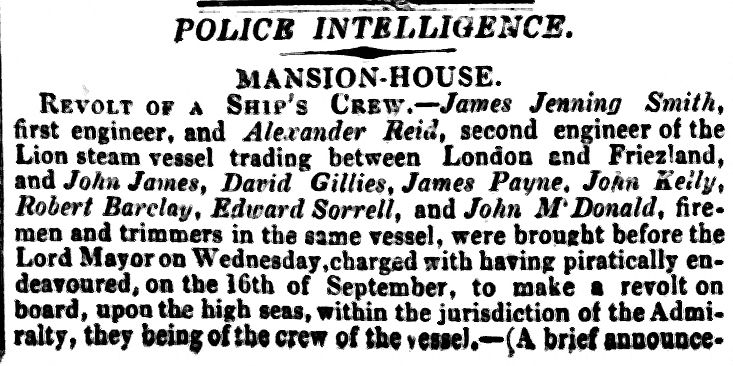
Shipping and Mercantile Gazette, No 3292, 28 Sep 1848, Page 4, Col 2, Police Intelligence, James Jennings Smith (Download this image)

Shipping and Mercantile Gazette, No 3292, 28 Sep 1848, Page 4, Col 3, Police Intelligence Contd, James Jennings Smith (Download this image)
Transcription
POLICE INTELLIGENCE.MANSION-HOUSE.
REVOLT OF A SHIP’S CREW. — James Jenning Smith, first engineer, and Alexander Reid, second engineer of the Lion steam vessel trading between London and Friesland, and John James, David Gillies, James Payne, John Kelly, Robert Barclay, Edward Sorrell, and John M’Donald, firemen and trimmers in the same vessel, were brought before the Lord Mayor on Wednesday, charged with having piratically endeavoured, on the 16th of September, to make a revolt on board, upon the high seas, within the jurisdiction of the Admiralty, they being of the crew of the vessel. — (A brief announcement of the case appeared in the Shipping and Mercantile Gazette of yesterday.)-Mr. Pelham sppeared for the prosecutors, Messrs. Robinson, the owners; and Mr. Smith attended for all the prisoners.-Mr. Smith, at the commencement of the proceedings, stated that the first engineer had applied to institute proceedings against the master of the vessel, but not having his evidence at hand a delay had necessarily taken place, and in the interim he had been taken into custody upon the extraordinary charge upon which so many of the persons employed were brought forward. - Mr. Pelham said the motive of the first engineer was evident enough, as he well knew the nature of the accusation, which he must himself answer upon the representation of the master.- Mr. Smith then objected to jurisdiction of the Lord Mayor in a case in which an offence alleged to have been committed on the high seas was to be adjudicated upon.- The Lord Mayor overruled the objection, upon the ground that the Central Criminal Court Bill established his jurisdiction in matters of criminal investigation.-Mr. Pelham stated that he appeared upon the part of Messrs. Robinson, under the 9th section of the 11th and 12th William III., to prosecute the prisoners for the commission of an offence of a most serious nature, especially in the consequences it was calculated to inflict upon merchants and traders. He then gave an outline of the case, which the following evidence discloses:- Mr. H. W. Neville said, I am the master of the Lion steam-ship, trading between London and Friezland, in Holland. I quitted London for a voyage to Friesland on the 13th of September, taking with me, as part of the crew, the crew. whole of the prisoners at the bar. They each of them possessed a registered ticket, and I received them in due course, and placed their names on the muster-roll. We arrived at Harlingen on Thursday morning, the day after we left the port, and took on board a general cargo of butter, cheese, flax, corn, and oil, and also live stock, consisting of 700 or 800 oxen, calves and sheep, and we were to be ready on the 16th, by half-past nine o’clock, to return. The fires were lit some time previous. About eight o’clock I observed a quantity of poultry brought on board in baskets by the firemen, and, upon inquiring whose they were, was answered that they belonged to Smith, the first engineer. I afterwards saw more brought on board, and was told they belonged to the same person, and I told them to keep them on shore, as I would no not allow them to be on board. A few minutes afterwards I observed Smith come from the shore over the paddle-box. He held up his fist to me and said, “You won’t let my fowls come on board, won’t you?” I told him I would not allow it, there were too many. He then said, “You —-, then I’ll pay the freight for them.” I then said, “They shall not come on board at all.” He said, clapping his hands, Now I’ve got you, you —-, I’ll learn you a trick. I’ll teach you and your Mr. Robinson a trick. I’ll stop the ship. This is what I intended. I’ve been scheming this for you." He then called to the firemen below, “Rake the fires out, you —-; rake the fires out.” I then said to him." Come here, don’t make a fool of yourself, and do that which you’ll be sorry for hereafter." He refused to hear me, and he ran off the paddle bridge, ordering the firemen again ering to rake the fires out and to bring the poultry ashore along with them. After giving directions to the chief mate I went ashore, and sent for the agent of the ship that he might expostulate with Smith and the firemen. When I told him what took place be sent for Mr. Harrison, a merchant in the place, who took Smith along the pier to talk with him, and came on board after having walked nearly an hour with him. I then sent for the consul, the prisoners having all gone ashore except M’Donald, and I sent the mate to tell them all in the presence of the consul to come aft to the cabin, and when they came I asked them one by one if they intended to resume their duty. Smith told the rest not to say anything, as the —- would only catch them. I then asked the firemen and trimmers and the second engineer if they would not do their duty, and obey my orders in getting steam? All except M’Donald, and a man named Rayner, who is not here, said, “No, they would not unless Smith did.” Smith was present at the time. I then went with the consul, and delivered to him the registered tickets of all the men, and they all went ashore except M’Donald, who went ashore an hour afterwards. Two of them came back several times, to endeavour to get Rayner to go, but he said he would do his duty. After some time the consul and Mr. Harrison came on board, and said that Smith and the rest would return to the vessel. (Here the witness detailed the particulars of another interview, at which, upon being again urged to return, Smith said, “No: take the ship to to London yourselves. Revenge I mean to have.”) Witness continued: They then came down close to the ship, and as I appeared on deck Smith called out, “You —-, Captain Neville, where is your Mr. Robinson now? Why not take the ship away?” And that sort of abuse was continued during the whole of the afternoon as I passed from the ship to the shore. I omitted to state at the commencement that Smith said, shaking his fist at me, “Now, write to Robinson what a —- rogue of a captain and an agent they have got, and that he would learn Mr. Robinson whether he (Robinson) was to treat him like a —- dog.” On the Saturday following, whilst I was standing slongside of the ship, he came up, shaking his fist in my face, and said, “You —-,I’ll fight you.” I said, “No, that you won’t, I know;” upon which he said I was a “—- cur.” After detailing the particulars of another ineffectual effort to induce Smith to return to his duty, the witness stated that, instead of leaving Harlingen on Saturday, the 16th, in the morning, he was detained until Tuesday, the 19th, at noon, in consequence of the desertion, and was obliged to tranship the live stock at a great expense to the owners. In the ordinary course the ship would have arrived on Sunday afternoon in London, so as to have the live stock ready for Tuesday morning’s market.-Mr. Pelham here produced the consul’s certificate, stating the positive refusal of all the prisoners to return to their duty, notwithstanding the most energetic exertions to prevail upon them.-Mr. Neville: It was necessary to have recourse to the soldiers and the police to protect the crew and the ship, and the firemen who remained on board. The agent wrote to Mr. Robinson an account of the transactions, and on my arrival the necessary proceedings were adopted. Mr. Smith, the solicitor for the prisoners, cross-examined this witness at considerable length. He repeated some of the most prominent parts of his evidence in chief with increased emphasis. He had, be said, applied for the soldiers himself, as be considered such a precaution necessary for the protection of the ship and the crew, and he believed, upon his oath, that the ship and himself were in danger. There was no one on board competent to act as principal engineer except Smith, and all the rest of the prisoners had refused to return to their duty unless Smith returned. They could have resumed their work until he had got engineers, but they would not. In answer to questions as to the character of Smith, Mr. Neville said he had known the first engineer about six months, and had never found any fault with him before, nor had he found any with any of the other men. Mr. Smith, solicitor for the prisoners. submitted that it did not appear that M’Donald had joined the rest in a leaving the ship, and as the evidence did not implicate that person, it would be but fair to discharge him at once.-The Lord Mayor said that M’Donald refused to return to his duty, and that, although he lingered on board an hour longer than the rest, he at last followed them. What had been stated might be adduced in alleviation, but it certainly must not have the effect of discharging him from his share of the responsibility. Mr. Smith (solicitor to the prisoners) requested to be allowed to ask, in fairness to the majority of his clients, whether they had not stated to thu [sic] master that they would return to the vessel if he could obtain competent engineer?-Mr. Neville: Never. They positively refused if Smith would not return.-Mr. Pelham requested that the Lord Mayor would postpone his next examination for a week, when it would be in his power to complete the evidence. Mr. Smith (solicitor to the prisoners) applied for leave for such of his clients as might be able to procure bail to give in securities for their appearance.-The Lord Mayor said he could not, in a case of so important a nature, consent to take bail, and all the prisoners were accordingly remanded. Several of them (and Smith amongst the number) denied the truth of some of the most immaterial parts of the testimony of Mr. Neville, whose statements received additional strength from his cross-examination.
Other Information
6 events have been derived from this evidence.
- James Jennings Smith★ was entered on 27 Sep, 1848
- James Jennings Smith★ was Tried before the Lord Mayor on a charge of piratical revolt on 27 Sep, 1848 at Mansion House, London, England
Full Citation
Shipping and Mercantile Gazette; No 3292, 28 Sep 1848, Page 4, Cols 2 and 3, Police Intelligence.
Source
Shipping and Mercantile Gazette
Available at:
- Findmypast. https://www.findmypast.co.uk/newspapers/england/shipping-and-mercantile-gazette
- The British Newspaper Archive. https://www.britishnewspaperarchive.co.uk/titles/shipping-and-mercantile-gazette