No 20737, 30 Nov 1848, Page 7, Col 5, Curious Case of Sea Wages
Cited from Morning Herald (London)
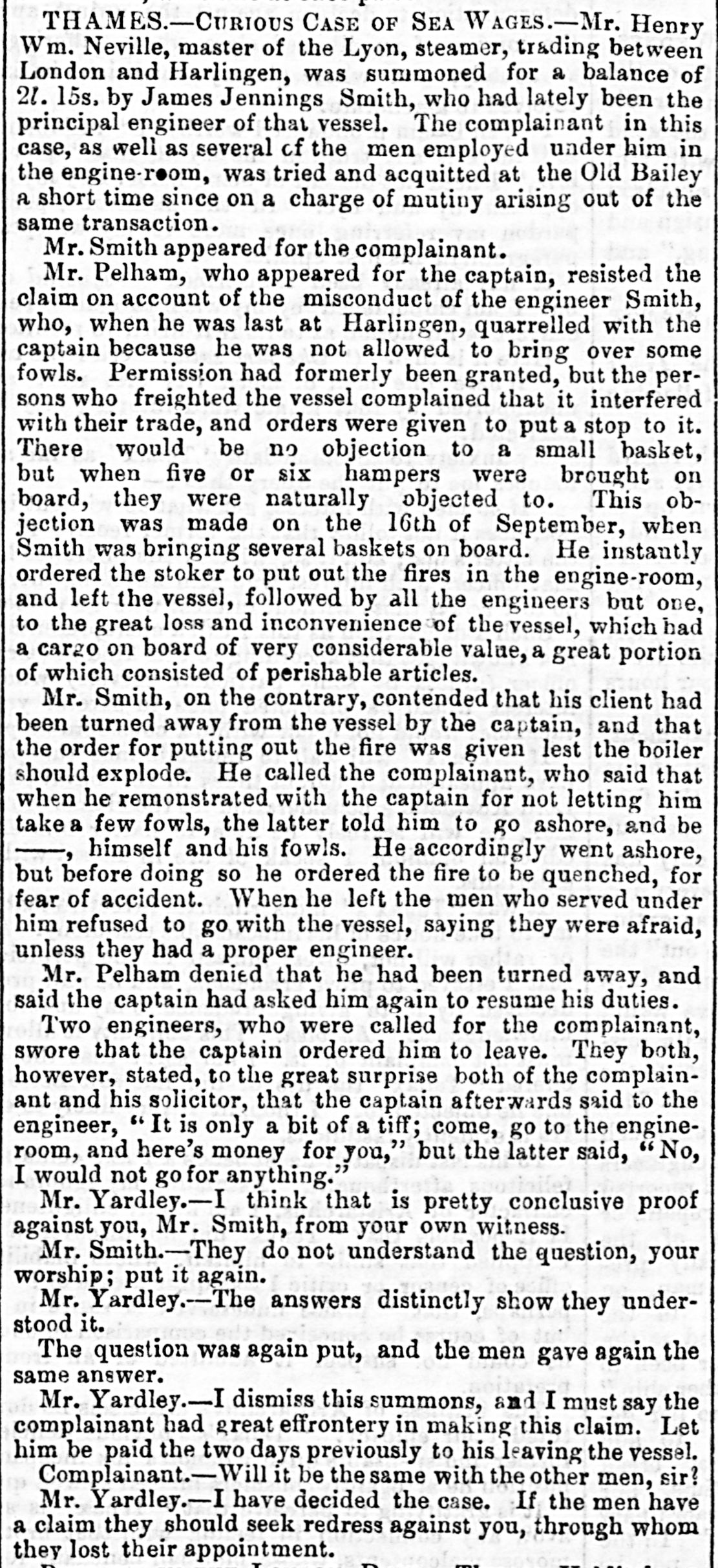
Morning Herald London, No 20737, 30 Nov 1848, Page 7, Col 5, Curious Case of Sea Wages, James Jennings Smith (Download this image)
Transcription
THAMES. - CURIOUS CASE OF SEA WAGES. - Mr. Henry Wm. Neville, master of the Lyon, steamer, trading between London and Harlingen, was summoned for a balance of 2l. 15s. by James Jennings Smith, who had lately been the principal engineer of that vessel. The complainant in this case, as well as several of the men employed under him in the engine-room, was tried and acquitted at the Old Bailey a short time since on a charge of mutiny arising out of the same transaction.Mr. Smith appeared for the complainant.
Mr. Pelham, who appeared for the captain, resisted the claim on account of the misconduct of the engineer Smith, who, when he was last at Harlingen, quarrelled with the captain because he was not allowed to bring over some fowls. Permission had formerly been granted, but the persons who freighted the vessel complained that it interfered with their trade, and orders were given to put a stop to it. There would be no objection to a small basket, but when five or six hampers were brought on board, they were naturally objected to. This objection was made on the 16th of September, when Smith was bringing several baskets on board. He instantly ordered the stoker to put out the fires in the engine-room, and left the vessel, followed by all the engineers but one, to the great loss and inconvenience of the vessel, which had a cargo on board of very considerable value, a great portion of which consisted of perishable articles.
Mr. Smith, on the contrary, contended that his client had been turned away from the vessel by the captain, and that the order for putting out the fire was given lest the boiler should explode. He called the complainant, who said that when he remonstrated with the captain for not letting him take a few fowls, the latter told him to go ashore, and be off, himself and his fowls. He accordingly went ashore, but before doing so he ordered the fire to be quenched, for fear of accident. When he left the men who served under him refused to go with the vessel, saying they were afraid, unless they had a proper engineer.
Mr. Pelham denied that he had been turned away, and said the captain had asked him again to resume his duties.
Two engineers, who were called for the complainant, swore that the captain ordered him to leave. They both, however, stated, to the great surprise both of the complainant and his solicitor, that the captain afterwards said to the engineer, “It is only a bit of a tiff; come, go to the engine-room, and here’s money for you,” but the latter said, “No, I would not go for anything.”
Mr. Yardley - I think that is pretty conclusive proof against you, Mr. Smith, from your own witness.
Mr. Smith - They do not understand the question, your worship; put it again.
Mr. Yardley - The answers distinctly show they understood it.
The question was again put, and the men gave again the same answer.
Mr. Yardley - I dismiss this summons, and I must say the complainant had a great effrontery in making this claim. Let him be paid the two days previously to his leaving the vessel.
Complainant - Will it be the same with the other men, sir?
Mr. Yardley - I have decided the case. If the men have a claim they should seek redress against you, through whom they lost their appointment.
Full Citation
Morning Herald (London); No 20737, 30 Nov 1848, Page 7, Col 5, Curious Case of Sea Wages.
Source
Morning Herald (London)
Available at:
- The British Newspaper Archive. https://britishnewspaperarchive.co.uk/titles/morning-herald-london