How are the Hewitts connected to the Rogers?
Written by Ian Davis. Last updated 6 April 2026.
Background
While looking for parents of Alfred Rogers (see Who were the parents of Alfred Rogers) using the Leeds method we noticed a cluster of fairly DNA matches that appeared to be related via the Hewitt surname. We found ten that we could connect directly together on a tree and several more that appear to be closely related to the rest but did not have enough information to place on a tree in relation to the others.
Further investigation showed that several of the Hewitt matches were also matching with other known Rogers relatives that we have already traced through DNA and genealogical evidence. All of these were descendants of Alfred Rogers and his wife Sarah Ann Whitbread (1848–?). We have other DNA matches traced back to the Whitbreads that do not match the Hewitts so we feel fairly confident that the Hewitts are related to the Rogers and may offer clues to Alfred’s parents.
Discussion
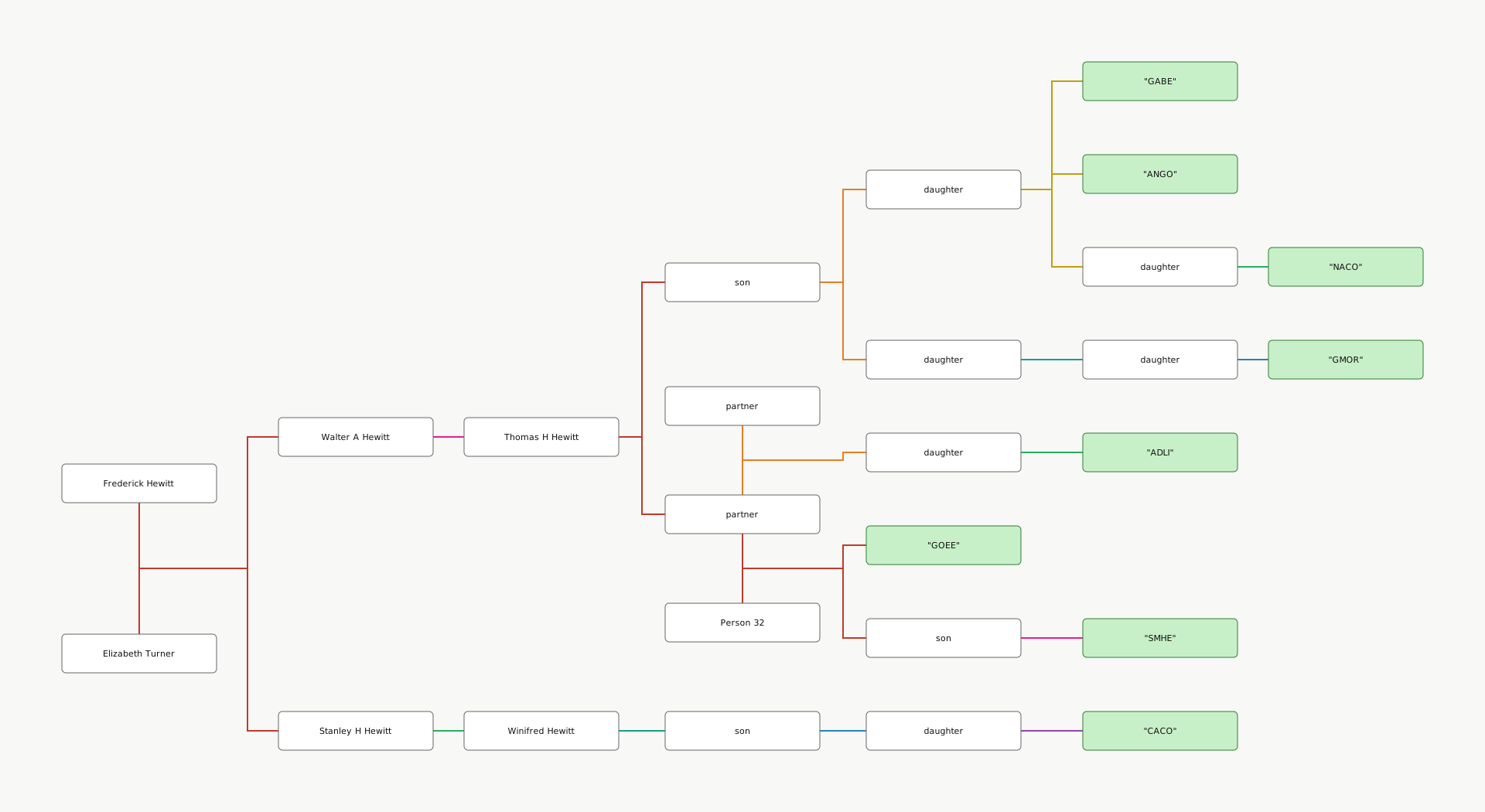
The ten DNA matches we could trace were all descended from Frederick Hewitt (1793-1883) and his wife Elizabeth Turner (1800-1874). They married in 1821 in Clapham, Surrey and raised twelve children in that area. In the 1841 census the family are living in Old Town in Clapham, an area noted for its large houses and wealthy residents. Frederick is recorded as a being of independent means. In 1851 the family were still at the same address but Frederick was now recorded as being a “proprietor of houses”.
Two of the DNA matches were descended from one of the matches so they’re not used in this analysis as they won’t add any independent DNA. The matches have been assigned codenames to preserve privacy.
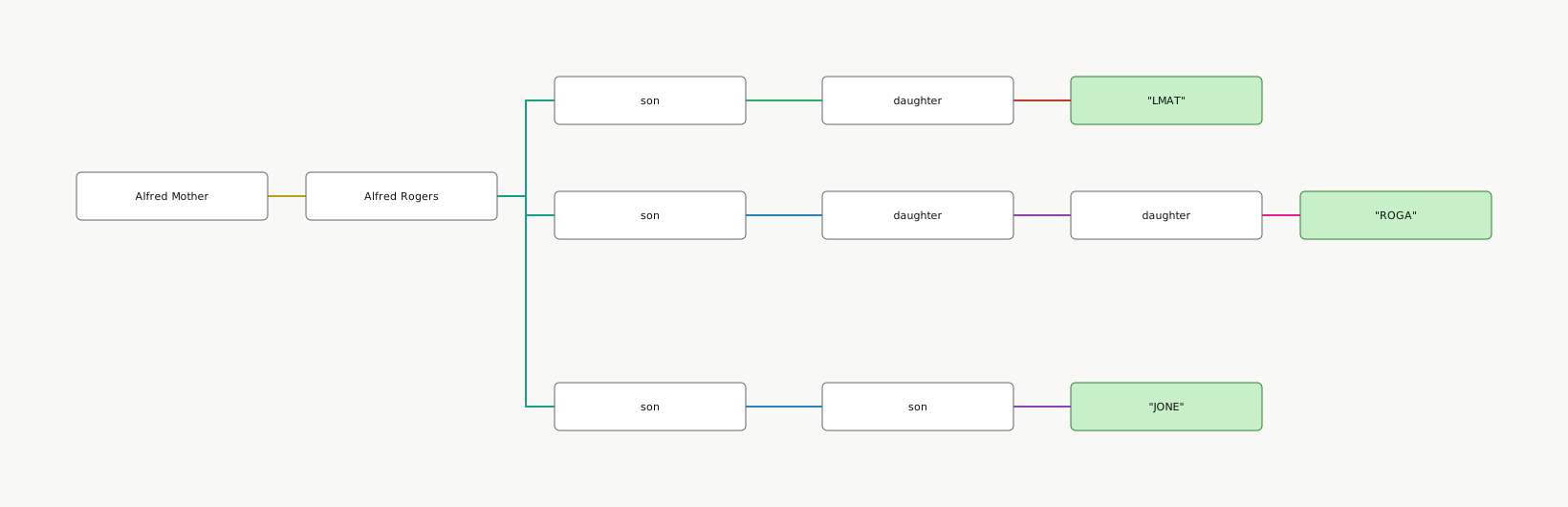
The Rogers DNA matches that showed some connection to the Hewitts all appear to descend from Alfred Rogers:
Relationship Analysis using BanyanDNA
BanyanDNA is an online tool that enables the user to create a tree, assign centimorgan values to pairs of people on the tree and then analyse how statistically likely the relationships in the tree.
The number of centimorgans of DNA shared between two individuals isn’t enough to pinpoint their precise relationship since there are many possible relationships that could result in the same centimorgan value. However when a group of people who are all interrelated are analysed as a whole then it reduces the number of relationships that are possible or statistically likely.
The BanyanDNA tool can perform this analysis. We knew the Rogers relationships accurately and felt we had built a good tree for the Hewitt group and the primary unknown was where these two groups of people became related.
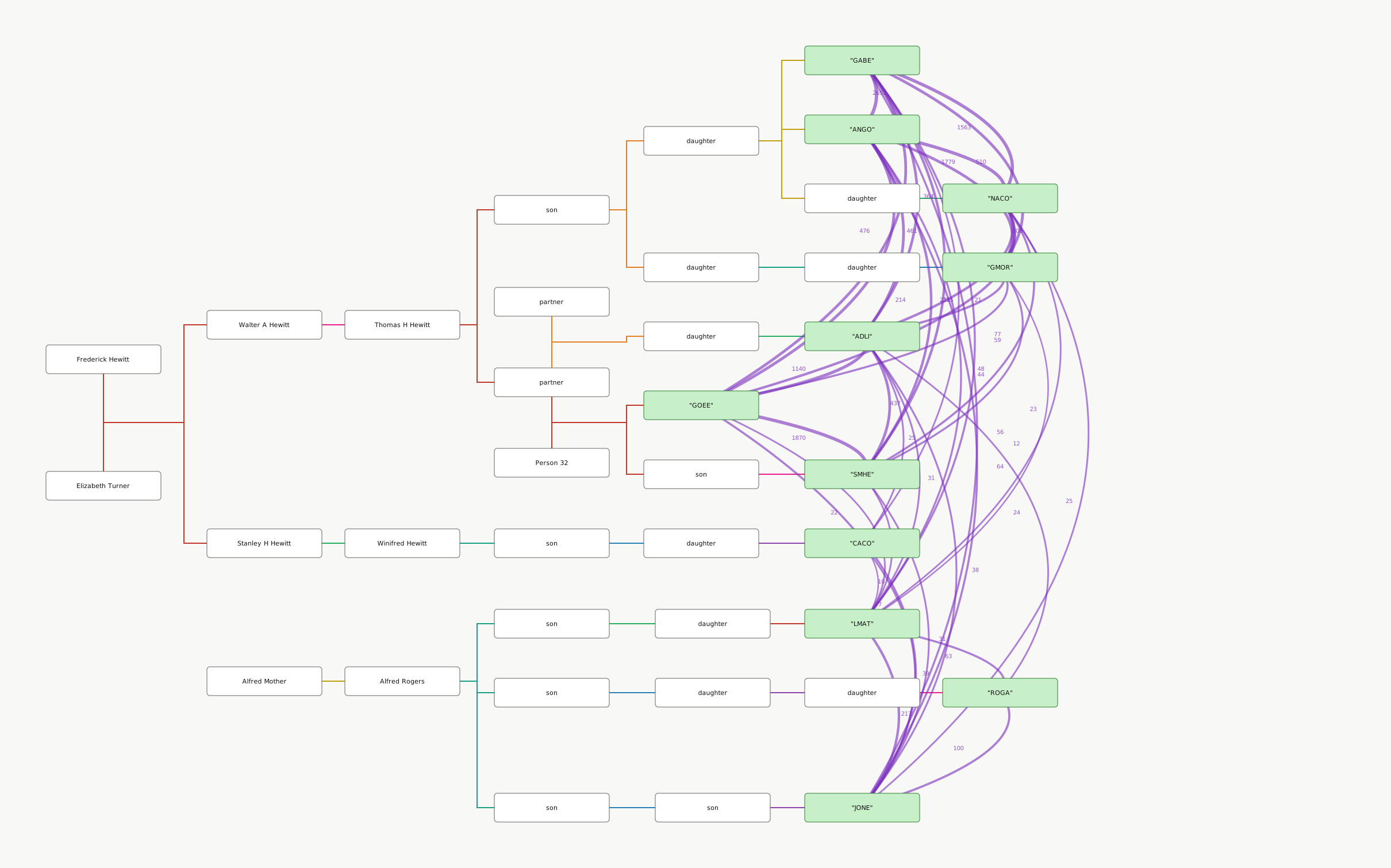
This matrix shows the centimorgans of DNA shared between the DNA test takers in the three groups. The Hewitt descendants are highlighted in purple. As can be seen the amount of shared cM is not high and on their own it would be difficult to infer any particular common ancestor. However, given the interconnected groups it gives more credence to their being a common ancestor for all the people tested.
| ADLI | ANGO | CACO | GABE | GMOR | GOEE | JONE | LMAT | NACO | ROGA | SMHE | |
|---|---|---|---|---|---|---|---|---|---|---|---|
| ADLI | — | 461 | 25 | 364 | 115 | 1140 | 38 | 31 | 229 | 24 | 437 |
| ANGO | 461 | — | 2651 | 512 | 624 | 64 | 44 | 1779 | 236 | ||
| CACO | 25 | — | 21 | 39 | 10 | ||||||
| GABE | 364 | 2651 | 21 | — | 510 | 476 | 56 | 59 | 1563 | 252 | |
| GMOR | 115 | 512 | 510 | — | 63 | 12 | 200 | 48 | |||
| GOEE | 1140 | 624 | 476 | 63 | — | 77 | 22 | 214 | 1870 | ||
| JONE | 38 | 64 | 39 | 56 | 77 | — | 217 | 25 | 100 | 31 | |
| LMAT | 31 | 44 | 10 | 59 | 12 | 22 | 217 | — | 23 | 63 | 24 |
| NACO | 229 | 1779 | 1563 | 200 | 214 | 25 | 23 | — | 77 | ||
| ROGA | 24 | 100 | 63 | — | |||||||
| SMHE | 437 | 236 | 252 | 48 | 1870 | 31 | 24 | 77 | — |
That the two groups are densely connected can be seen in this diagram. Each purple arc links two DNA test takers who have been found to share some quantity of DNA.
Emma Wood Rogers
Our investigation into the parents of Alfred Rogers had already led us to a birth in 1844 in Lambeth. This Alfred was the illegitimate son of Emma Wood Rogers who appears to have been born in Chichester in Sussex in 1821. Emma had two further illegimate children: William J Rogers in 1847 and Henry Jenkins Wood Rogers in 1850.
Alfred was born at The White House, Vauxhall Walk in Lambeth. By 1851 Emma and her three sons were living in William Street off Waterloo Road in Lambeth. Vauxhall Walk is less than two miles from Clapham Old Town where the Hewitt family were living at the time.
The proximity of Alfred to the Hewitts gives credence to our theory that this Alfred was our ancestor and, with the DNA evidence, one of the Hewitts was his father.
We don’t know Emma’s occupation. In the 1851 she had a room in a house with two other families and her occupation was given as needlewoman. This implies that she was supporting herself and her three sons by taking in clothing to mend. However we shouldn’t ignore the possibility that Emma may have been working as a prostitute at this time and that stating needlework was a plausible cover because it was common, low-status, and could be done from home without requiring much verification.
The Rogers family later
We know our ancestor Alfred was working in Irchester, Northamptonshire as a Shoemaker in 1868. He stated at the time that his father was Joseph Rogers. In later census returns his place of birth was consistently recorded as London. One question we have is how he came to leave London and take up the trade of shoemaking in Northamptonshire, rather than any other trade in the huge pool of jobs available in London.
Our assumption is that Alfred didn’t know his father, and simply stated Joseph. This may not be a valid assumption, but we have exhaustively searched for Alfreds born in the London area with a father called Joseph.
If our Alfred was the illegitimate son of Emma Wood Rogers as we believe then there is one additional clue. We think Emma’s son William also left London for Northamptonshire. In 1861 he is working as a servant in Flore, about 20 miles from Irchester. Again, we have to wonder how he had the means to look for work outside of London.
In 1861 Emma is working as a servant to a Maria Botwell in Camberwell, about two miles from Lambeth and Clapham.
Hypotheses
These hypothesis are the arrangements that best fit the evidence as analysed by BanyanDNA. There are other possibilities that fit but leave certain relationships as out of the usual spread of shared DNA. Since inheritance of DNA is probabilistic and we are dealing with very small amounts (1-3 shared segments, 10-60 cM) there can be a lot of variability in the solutions.
We attempted to validate different scenarios by altering specific relationships and asking BanyanDNA to verify the relationships. BanyanDNA provides an estimate of how plausible a scenario is via a chi-square value which ranges from 0 to 1, with higher values indicating a greater degree of consistency. We used a setting of 5000 trials which is labelled as very high precision but to the statistical nature of the verification the chi-square value might change by 0.1 or so in repeated runs.
Hypothesis 1: Frederick Hewitt was the father of Alfred Rogers
This arrangement has a strong confidence score (Chi-Square 0.98) with most relationships being within one standard deviation of the expected amount of shared DNA and most are within 1.5 standard deviations. Notable outliers:
- “LMAT” and “GABE” here are half-3rd cousins 1x removed and can be expected to share 1-34 cM, but share 64, implying a closer relationship by at least a generation. The error here is only 1.8 standard deviations though.
- The same can be said for “JONE” and “ANGO” who share 59 and also for “JONE” and “GABE” who share 55. These are also half-3rd cousin 1x removed relations.
At the time of Joseph’s birth in 1844 Frederick would have been 51. His last child with his wife Elizabeth was Stanley in 1842.
As a proprietor of houses it’s plausible that Frederick and Emma met as landlord and tenant. It might be possible to prove this with land records, for example if Frederick owned the White House where Alfred was born.
We can’t know if Frederick was aware of having a son by Emma. If they had a long standing relationship then it’s possible he did know and it could be possible that William and Henry were also his children. However Henry’s full name “Henry Jenkins Wood Rogers” makes that idea less likely, with Jenkins suggesting the name of another father.
If Frederick was aware of Alfred then he would have had the means to fund the boy’s apprenticeship as a shoemaker in Northamptonshire, and the same could be said for William’s move to Flore. It’s also possible, with his connections, that he found Emma a role as a servant in a nice house in Camberwell.
Hypothesis 2: A son of Frederick Hewitt was the father of Alfred Rogers
Here the father of Alfred Rogers was one of the elder sons of Frederick, such as Frederick Hughes born 1822 or Arthur Turner born 1824. These men would have been of a similar age to Emma who was baptised in 1821.
This arrangement also has a strong confidence score (Chi-Square 0.96) with most relationships being within one standard deviation of the expected amount of shared DNA and most are within 1.5 standard deviations. This has similar outliers to Hypothesis 1:
- “LMAT” and “JONE” are 4th cousins of “GABE” and “ANGO” and can be expected to share 1-32 centimorgans but share 55-64. This hypothesis puts them further apart than Hypothesis 1
Hypothesis 3: Frederick’s son Walter A Hewitt was the father of Alfred Rogers
Here the father of Alfred Rogers is Walter Hewitt, the ancestor of the majority of the Hewitt DNA matches.
This arrangement has the strongest confidence score (Chi-Square 1.00) with most relationships being within one standard deviation of the expected amount of shared DNA and most are within 1.5 standard deviations.
The problem with the outliers in the previous two hypotheses is resolved: “LMAT” and “JONE” are half 3rd cousins of “GABE” and “ANGO” and as such can be expected to share 1-60 centimorgans which is consistent with the 55-64 centimorgans actually shared.
However, the obvious problem here is that Walter was born in 1831, making him just 13 when Alfred was born and 12 at conception. While not impossible, this seems highly implausible.
Possible research avenues
The DNA evidence seems to strongly suggest that Alfred’s father was one of the Hewitts so research has to focus on (a) disproving this conclusion and (b) identifying which member of the family was the father.
- Look for DNA matches to Hewitts that match our relatives other than descendants of Alfred Rogers. Finding one of these would disprove all the hypotheses.
- Look for more Hewitt DNA matches to strengthen the evidence.
- Did Frederick Hewitt mention Alfred or Emma in his will (1883)?
- Did Frederick Hewitt own any property associated with Emma? Was she a tenant?
- Is there any link between Emma’s employer Maria Botwell in Camberwell and Frederick Hewitt?
- Are there any apprenticeship papers for Alfred that might make a connection to the Hewitts?
- What did Frederick Hughes Hewitt and Arthur Turner Hewitt do in later life. Is there any connection to Alfred or Emma?
- Is there any connection between the Hewitt family and Northamptonshire?
- Contact Hewitt DNA matches to ask whether there was any hint of half-brothers in the family.